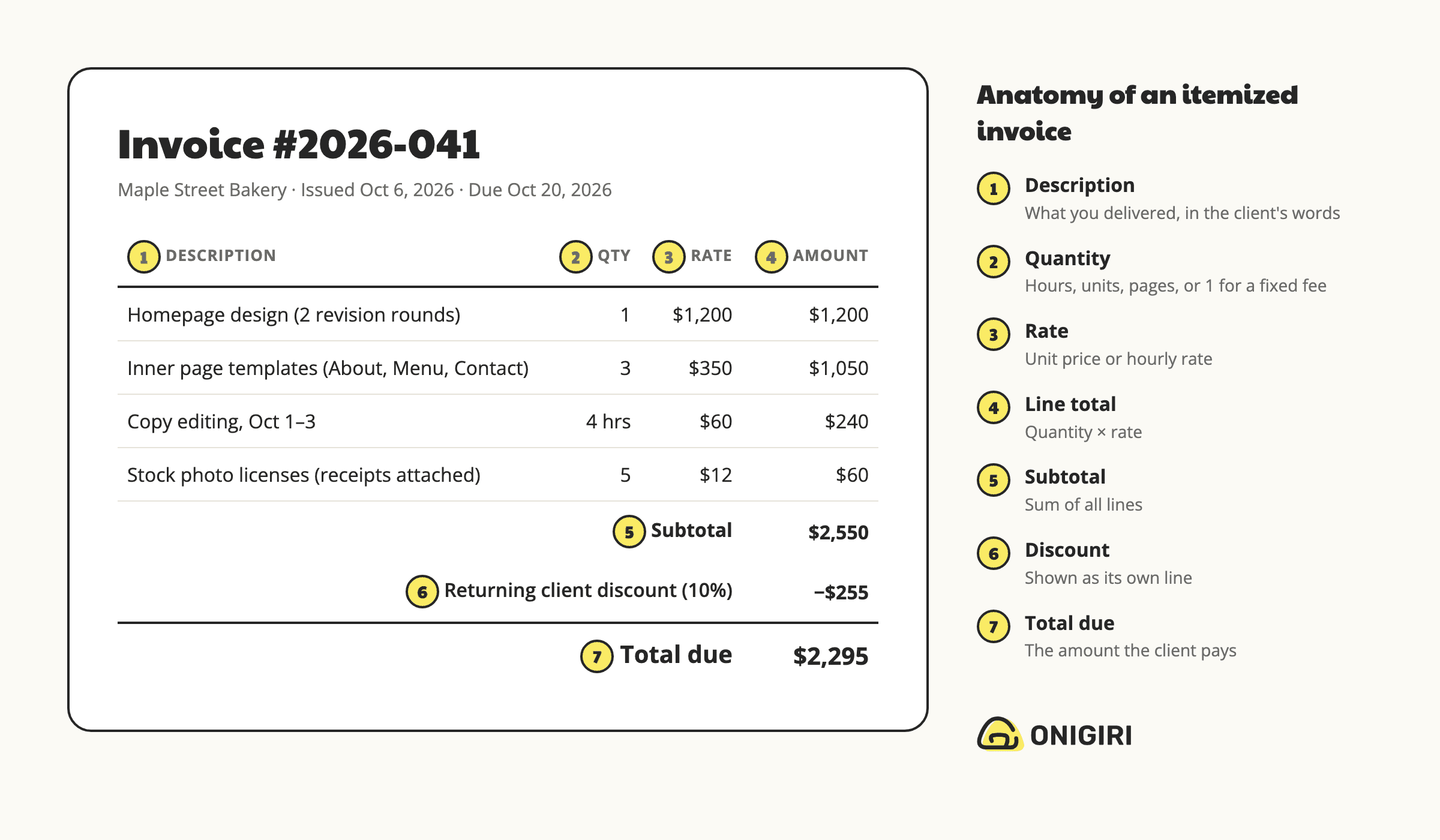

An itemized invoice is an invoice that lists every product or service you're charging for as its own line, with a description, quantity, rate and total. Instead of one number at the bottom ("Website: $2,295"), the client sees exactly what they're paying for and how you got to the total.
For freelancers, itemizing is one of the simplest ways to get invoices approved faster. Clear line items answer questions before the client has to ask them. Below you'll find what an itemized invoice includes, a worked example, how to write line items that don't get disputed, and when itemizing is legally required.
Key takeaways
An itemized invoice breaks your total into separate lines: description, quantity, unit rate and line total.
Below the lines you show the subtotal, any discount and tax, and the total amount due.
Itemizing reduces disputes, speeds up approval, and gives you and your client better records.
In the UK, a full VAT invoice must be itemized by law. In the US it's usually best practice rather than a legal rule, but some laws and contracts require itemization.
Name line items the way your quote or contract does, so the client can match them at a glance.
What an itemized invoice includes
An itemized invoice has the same core parts as any invoice, plus a detailed breakdown of charges.
Header
Invoice number: a unique number for tracking and reference
Issue date and due date
Your name or business name, address and contact details
Client details
Client name, company and billing address
Contact person or billing email
PO number or project reference, if the client uses one
Line items (one row per product or service)
Description: what you did or supplied, specific enough to recognize
Quantity: hours, units, pages, days, or simply 1 for a fixed-fee item
Rate: the unit price or hourly rate
Line total: quantity × rate
Totals
Subtotal of all lines
Discounts, shown as their own line
Tax, if you charge it, with the rate
Any other charges, such as shipping or reimbursable expenses
Total amount due
Payment details
Payment terms (for example, "Due October 30, 2026")
How to pay: bank transfer details, a card payment link, or both
Late fee terms, if your agreement includes them
Itemized invoice example
Here's what an itemized invoice looks like for a small web design project:
Invoice #2026-041 · Issued October 6, 2026 · Due October 20, 2026
Bill to: Maple Street Bakery, Attn: Accounts Payable
Description | Qty | Rate | Amount |
|---|---|---|---|
Homepage design (2 revision rounds) | 1 | $1,200 | $1,200 |
Inner page templates (About, Menu, Contact) | 3 | $350 | $1,050 |
Copy editing, Oct 1–3 | 4 hrs | $60 | $240 |
Stock photo licenses (receipts attached) | 5 | $12 | $60 |
Subtotal | $2,550 | ||
Returning client discount (10%) | −$255 | ||
Total due | $2,295 |
Payment: card payment link or bank transfer (details below). Late payments are subject to the fee stated in our agreement.
A few things make this example work:
Each line matches an item in the original quote, so the client can check it in seconds.
Hourly work shows hours and rate, so the math is visible.
The expense (stock photos) is separate from the fee and backed by receipts.
The discount is its own line, so the client sees the full value and the saving.
This example has no tax line. Whether you need to charge sales tax or VAT depends on what you sell and where, so check your local rules. To build one yourself, try our free invoice generator or start from the web design invoice template.
Itemized vs. summary invoice
Itemized invoice | Summary invoice | |
|---|---|---|
What it shows | Every product or service on its own line, with qty, rate and line total | A single description and a total |
Best for | Most freelance and project work, hourly billing, anything with extras | A single fixed-fee item the client has already approved in detail |
Client approval | Faster: the detail is already there | Slower if the client needs to ask what's included |
Dispute risk | Lower | Higher |
Record-keeping | Detailed history of what you sold and at what price | Totals only |
If you bill one client for many jobs at once, you may also come across a consolidated invoice, which groups several invoices or periods into one bill. Our post on consolidated invoices explains when that makes sense. Consolidated invoices are usually still itemized.
How to write line items clients approve quickly
Good line items do most of the persuading for you. A few rules:
Use the client's language. Name items the way your quote, proposal or contract does. If the proposal said "Brand discovery workshop," don't invoice for "Strategy session."
Pick a sensible unit. Hours for hourly work, pages or words for writing, days for on-site work, and 1 for a fixed-fee deliverable. Don't turn a flat-fee project into fake hours.
Add just enough detail. "Logo design: 3 concepts, 2 revision rounds, final files in SVG and PNG" is clear. A paragraph per line isn't necessary.
Label extras clearly. Work outside the original scope should say so, ideally with a note on when it was approved: "Additional landing page (approved by email Oct 3)." Surprise charges are a common reason clients push back.
Separate fees from expenses. Software, stock assets, printing or travel go on their own lines, with receipts on hand.
Show discounts as a line. A visible discount reminds the client of the value they got. Burying it in a lower rate hides it.
Date recurring or hourly work. "Content updates, September 2026" or "Support, Oct 1–15" avoids confusion about which period you're billing.
If you're writing your first one, our guide on how to make an invoice covers the full process step by step.
Common itemized invoice mistakes
Too little detail. "Design work" on its own invites questions and delays payment.
Math errors. Line totals that don't equal quantity × rate, or tax applied to the wrong lines, make the client doubt the whole invoice.
Lines that don't match the quote. If names, quantities or prices differ from what was agreed, explain why on the invoice.
Missing payment terms. A perfect breakdown still needs a due date and payment instructions.
We cover these and more in our list of common invoicing mistakes.
When is an itemized invoice required?
For most freelancers, itemizing is good practice. In some situations it's a legal or contractual requirement.
UK: VAT invoices. If you're VAT-registered and supply standard- or reduced-rated goods or services to another VAT-registered business, you normally must issue a VAT invoice within 30 days of the supply. A full VAT invoice must show, among other things, a description sufficient to identify what you supplied, the quantity of goods or extent of services for each description, the unit price, the VAT rate, and the amount excluding VAT. In other words, it has to be itemized. Retailers can issue a simpler invoice for supplies of £250 or less.
US: contracts and state laws. There's no general federal rule that a freelancer's invoice must be itemized, but contracts and some local laws push in that direction. New York State's Freelance Isn't Free Act, in effect since August 28, 2024, gives freelancers paid $800 or more the right to a written contract that includes an itemization of all services, their value, and the rate and method of payment. When your contract is itemized, your invoice should match it line for line.
Client requirements. Larger companies and agencies often require itemized invoices, PO numbers and specific formats before they'll process payment. Ask for their vendor requirements before the first invoice.
Benefits of itemized invoices
Faster approval: clients and their accounts teams can match each line to what they agreed.
Fewer disputes: visible quantities and rates leave little room for "that's not what we discussed."
Better records: you can see what you sell most, at what price, and how your rates have changed.
Easier budgeting for clients: they see where their money went and can plan the next project.
Professional impression: a clear breakdown signals that you run a real business.
Create itemized invoices in minutes
Itemizing by hand in a spreadsheet works, but it's easy to slip on the math. In Onigiri, every invoice is itemized by default: you add line items as quantity × rate, save common services as item templates, apply tax rates and discounts, and the totals calculate themselves. You can send the invoice by email, share it as a link, or download a PDF. The free plan includes 3 invoices a month with no credit card. Create your first invoice free, or grab a free freelance invoice template or contractor invoice template if you prefer to start from a file.